
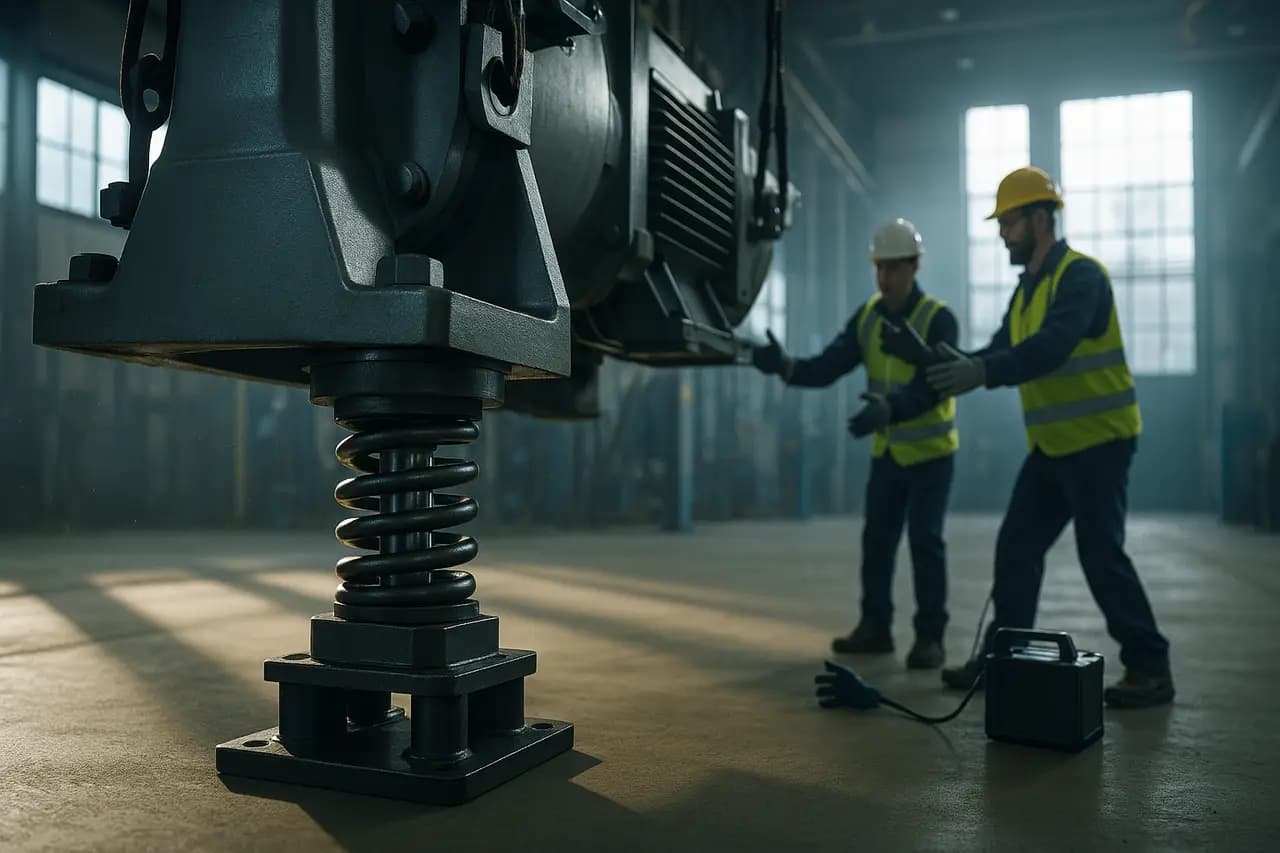
Vibration Isolation for Machines After Relocation
Ernest Parfentiev · Founder & Managing Director, NM SOLUTIONS
When a machine is relocated to a new hall, engineers often focus on leveling, grouting and re-alignment — and forget that the machine's dynamic behaviour depends heavily on how it is isolated from the floor. A press, a compressor or a CNC that ran quietly on its old foundation can transmit disturbing vibration into a new slab, ruin surface finish on nearby machines, or fatigue the structure over time. Getting vibration isolation right during reinstallation is a small line item that protects a large investment.
This guide explains how to assess, specify and install vibration isolation after a machine move — practically, and without over-engineering.
Why Vibration Isolation Changes After a Move
A machine's vibration signature is a system property, not just a machine property. When you relocate equipment, several variables change at once:
- New floor stiffness and mass. A thinner slab, a suspended floor, or a bay above a basement responds very differently from a thick ground-bearing foundation.
- New neighbours. Precision equipment (measuring machines, grinders, optical systems) installed nearby may be far more sensitive than at the old site.
- Different resonance conditions. The natural frequency of the machine-plus-mount system may now coincide with an excitation frequency, amplifying rather than damping vibration.
- Changed operating parameters. After recommissioning, speeds, cycle rates or product mix may differ from the original installation.
Because of this, isolation that worked perfectly for years at the old plant is not guaranteed to work at the new one. Treat it as a fresh engineering task.
Two Problems: Source Isolation and Receiver Isolation
Vibration control after relocation solves one of two problems — sometimes both.
Source (active) isolation
The machine itself generates vibration — reciprocating compressors, punching presses, hammer mills, centrifuges, unbalanced rotating masses. The goal is to prevent that energy from entering the floor and travelling to sensitive equipment or the building structure.
Receiver (passive) isolation
The machine is sensitive and must be protected from ambient floor vibration — coordinate measuring machines, high-precision lathes, semiconductor or optical equipment. Here the aim is to keep external disturbances out.
The design logic is similar, but the required performance and the acceptable settling behaviour differ, so define which case you are dealing with before selecting mounts.
The Key Principle: Frequency Ratio
Effective isolation depends on the ratio between the excitation (disturbing) frequency and the natural frequency of the isolated system. As a rule of thumb:
- Isolation only begins when the disturbing frequency is above about 1.4 times the system's natural frequency.
- Meaningful isolation requires a ratio of roughly 3 or more.
- Near a ratio of 1, you get resonance and amplification — the worst possible outcome.
In practice this means the isolator must be soft enough (low natural frequency) relative to the machine's operating speed. A high-speed spindle is easy to isolate; a slow, heavy reciprocating machine needs very soft springs and careful design.
Choosing the Right Isolator Type
After a relocation you generally choose among four families of isolators, based on the disturbing frequency, load and environment.
- Elastomer / rubber pads and mounts. Simple, cheap, durable. Good for higher-frequency, moderate-load machines. Natural frequencies typically in the range that suits many rotating machines. Sensitive to oil, ozone and temperature.
- Steel coil-spring isolators. For low-frequency, heavy sources (reciprocating compressors, large presses). Achieve very low natural frequencies but need horizontal stability and often damping.
- Air springs / pneumatic isolators. The lowest natural frequencies, with adjustable height and levelling. Ideal for very sensitive receivers such as metrology and optical benches. Require a clean, dry air supply.
- Levelling wedge mounts and machine feet. Combine isolation with fine height adjustment — convenient for machine tools where re-leveling after the move is also needed.
Do not simply reuse the old feet if the load path or floor has changed. Confirm the static load per point and the required deflection first.
A Practical Workflow at the New Site
1. Baseline the new floor
Before the machine arrives, measure ambient floor vibration in the target bay with a portable vibration analyser during normal plant operation. This reveals background levels, dominant frequencies and how quiet the location really is — essential for sensitive equipment.
2. Confirm loads and centre of gravity
Get the per-foot static load, total mass and centre of gravity from the machine documentation. Uneven load distribution means isolators of different stiffness at different points to keep the machine level and stable.
3. Select for the disturbing frequency
Identify the main excitation frequency (often the running speed, or the stroke rate for presses). Choose an isolator whose natural frequency is well below it to reach a safe frequency ratio.
4. Check floor capacity and load spreading
Soft isolators concentrate load on small footprints. Verify the slab can carry the point loads, and add spreader plates where needed — particularly on thinner or suspended floors.
5. Install, level and settle
Set the machine on the isolators, level it to the manufacturer's tolerance, and allow elastomer or spring mounts to settle before final adjustment. For air springs, set and check the levelling valves.
6. Verify by measurement
Run the machine at production speed and re-measure vibration — both transmitted into the floor and at the nearest sensitive equipment. Compare against the baseline and against any contractual or standard limits. Adjust stiffness or add damping if resonance appears.
Common Mistakes to Avoid
- Rigidly bolting a machine that used to be isolated. A hard connection to a new slab can turn the whole floor into a sounding board.
- Bridging the isolation. A single rigid pipe, conduit, cable tray or drain that bypasses the mounts short-circuits all the isolation. Use flexible connectors on every service line.
- Ignoring resonance. Selecting mounts by load rating alone, without checking the frequency ratio, is the classic cause of "it vibrates worse than before".
- Forgetting horizontal modes. Tall machines on soft springs can rock. Consider snubbers, cross-bracing or combined spring-damper units.
- Skipping the follow-up measurement. Isolation is only proven when the numbers confirm it under real production conditions.
When to Bring in Specialists
Many standard machines can be re-isolated with catalogue mounts and sound engineering judgement. But bring in vibration specialists when you have: very sensitive receivers, heavy low-frequency sources, complaints from adjacent tenants, suspended or upper-floor installations, or contractual vibration limits to meet. A short measurement campaign before and after installation is inexpensive compared with reworking a foundation or losing precision on a flagship machine.
Vibration isolation is one of those tasks that is easy to underestimate during a relocation and expensive to fix afterwards. Planning it as part of the reinstallation — with measurement, correct isolator selection and flexible service connections — keeps your machines precise, your neighbours happy and your new floor sound for the long term.
Related
Ernest Parfentiev
Founder & Managing Director, NM SOLUTIONS
NM Solutions specializes in the dismantling, relocation, installation and commissioning of industrial equipment and production lines across Europe — with hands-on project experience in metallurgy, food, packaging and building-materials plants.