
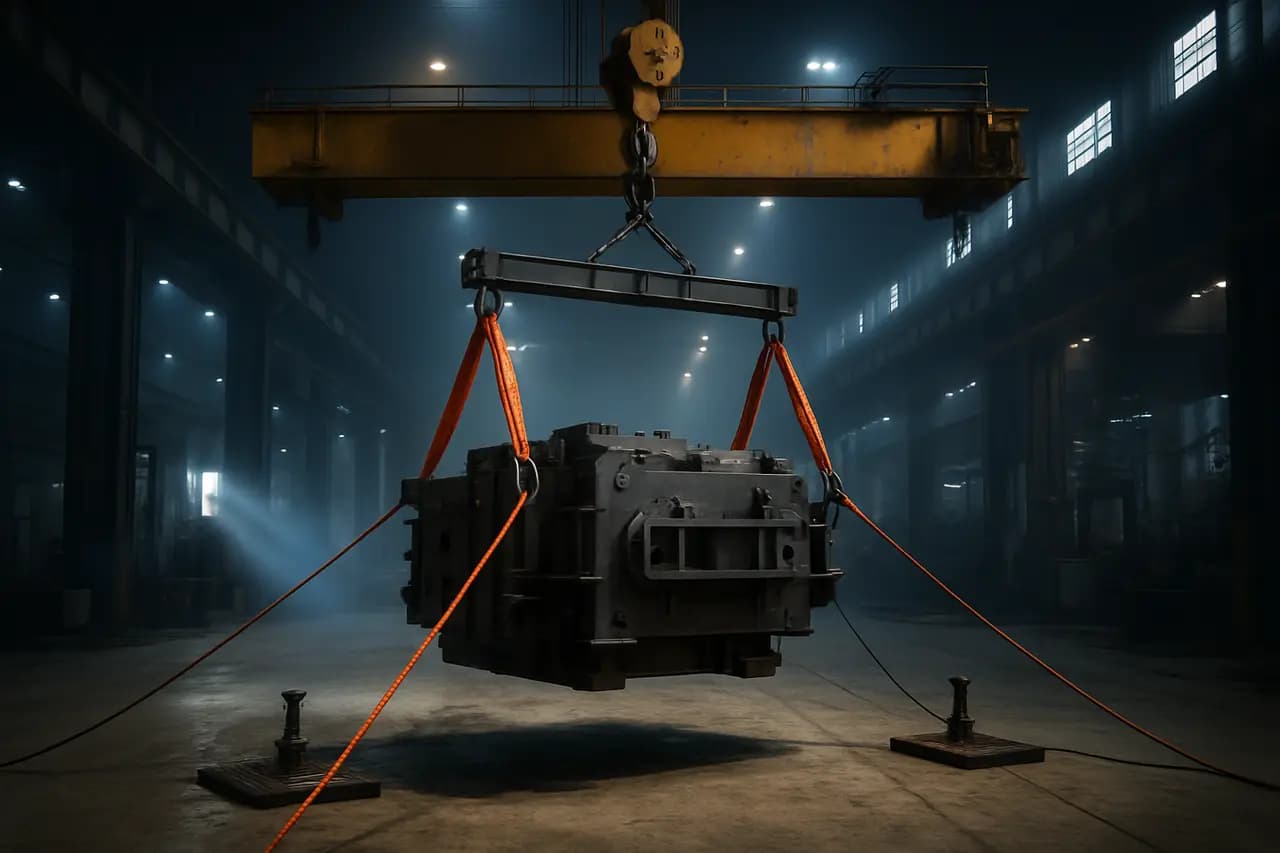
Rigging & Lifting Heavy Machinery: A Practical Field Guide
Ernest Parfentiev · Founder & Managing Director, NM SOLUTIONS
Rigging and lifting are where most heavy-machinery projects succeed or fail. A press, extruder, filler, or transformer that weighs 20 tonnes does not forgive improvisation: a misjudged centre of gravity or an under-rated sling can damage a machine worth more than the entire move and put people at serious risk. This guide explains how experienced teams plan and execute lifts during installation, dismantling, and relocation — and what to control on site.
Start With a Written Lift Plan
Every non-routine lift should have a documented plan before any gear comes out of the truck. A solid lift plan answers, in writing, the questions that cause accidents when left to assumption.
The plan should cover:
- Load data: verified weight, dimensions, and the centre of gravity. Use the machine nameplate, OEM drawings, or weighing — never a guess.
- Lifting points: certified eyebolts, lugs, or designed pick points. If none exist, define cradling or below-the-hook arrangements engineered for the load.
- Equipment selection: crane or gantry capacity, slings, shackles, spreader beams, and their working load limits (WLL).
- Geometry: sling angles, headroom, lift height, and swing path.
- Ground and structure: bearing capacity, outrigger pads, and floor loading limits indoors.
- People: appointed person, lift supervisor, slinger/signaller, and crane operator with defined responsibilities.
- Exclusion zones, weather limits, and a rescue/contingency plan.
For complex or tandem lifts, the plan should be reviewed by a competent lifting engineer and treated as a controlled document.
Get the Weight and Centre of Gravity Right
Most lift failures trace back to two numbers: total weight and centre of gravity (CoG). Machinery is rarely symmetrical — a motor, hydraulic pack, or counterweight shifts the CoG off the geometric centre. If the load is rigged as if the CoG were central, it will tilt the moment it leaves the ground.
Practical steps:
- Confirm weight from documentation; if unsure, weigh it with load cells.
- Estimate CoG from the heavy components and verify with a slow test lift just clear of the ground.
- Position the hook directly above the CoG so the load rises level.
- Be alert to dynamic effects: residual fluids, loose tooling, or trapped product can shift mass unexpectedly. Drain and secure everything beforehand.
A test lift of a few centimetres, held while the team checks balance and gear, is one of the cheapest insurance policies in the business.
Selecting and Inspecting Rigging Gear
Lifting accessories must be rated, certified, and inspected. Match the gear to the load, the angle, and the environment.
Slings
- Chain slings suit sharp edges, heat, and rough handling, but require corner protection only against burrs.
- Wire rope slings balance strength and flexibility for general heavy lifts.
- Polyester round slings and webbing are gentle on machined or coated surfaces but need edge protection against cutting.
Remember that sling capacity drops sharply as the angle from vertical increases. A two-leg sling at a wide included angle can carry far less per leg than the same sling near vertical — always read the rated capacity for the actual angle, never the straight pull figure.
Shackles, eyebolts, and beams
- Use shackles rated above the calculated leg load, with the correct pin orientation.
- Eyebolts must be fully seated; side loading a standard eyebolt drastically reduces its capacity.
- A spreader or lifting beam keeps slings vertical, reduces compressive load on the machine frame, and is often the difference between a safe lift and a crushed housing.
Inspect every item before use: no cracks, deformation, corrosion, cuts, or illegible markings. Reject anything questionable. Keep certificates with the lift plan.
Choosing the Right Crane or Lifting Method
Crane selection depends on weight, radius, height, and access — not just capacity. A crane's rated load falls as the boom extends and the radius grows, so a machine that is "within capacity" at the crane can be out of capacity at the placement point.
Common options:
- Mobile/all-terrain cranes for outdoor and yard lifts with good access.
- Overhead/gantry cranes for repeatable in-plant lifts within rated limits.
- Hydraulic gantries and skidding systems for low-headroom halls where a crane cannot reach.
- Forklifts and versa-lifts for compact, lower-weight moves on solid floors.
- Jacking, climbing, and air skates for precise positioning onto foundations.
For confined factory interiors, gantry-and-skid combinations often beat cranes because they move heavy loads horizontally with millimetre control and no swing.
Ground Conditions and Floor Loading
The load path does not stop at the hook — it continues into the ground or the structure. Outdoors, soft or backfilled ground can fail under outrigger pressure, dropping the crane. Indoors, mezzanines, basements, and service trenches under the slab can limit floor loading.
Controls that matter:
- Use adequately sized outrigger mats to spread point loads.
- Verify floor bearing capacity before routing heavy loads or positioning gantries indoors.
- Identify and bridge or avoid drains, pits, and underground utilities.
- Keep loads low during transit and avoid sudden stops that create dynamic peaks.
On-Site Execution and Communication
A good plan still needs disciplined execution. Before the lift:
- Hold a toolbox talk so everyone knows the sequence, signals, and exclusion zones.
- Confirm one slinger/signaller is in charge of directing the crane; agreed hand signals or a single radio channel prevent confusion.
- Clear the area; no one stands under a suspended load or in the swing path.
- Use tag lines to control rotation rather than hands on the load.
During the lift, raise slowly, pause for the test-lift check, and move at controlled speed. Stop immediately if anything is unexpected — a creaking frame, a shifting CoG, or a person entering the zone.
Stop-the-Job Triggers
Empower every team member to halt the lift. Clear triggers include:
- Wind or weather exceeding limits.
- Damaged or mis-rated gear discovered late.
- Uncertainty about weight, CoG, or ground conditions.
- Loss of clear communication or someone in the danger zone.
Stopping costs minutes; a dropped machine costs months.
Bringing It Together
Safe rigging is a chain of decisions: accurate load data, the right gear at the right angle, a crane or skidding system matched to the geometry, sound ground, and disciplined communication. None of these is glamorous, but together they protect people and preserve expensive equipment during installation, dismantling, and relocation. Treat every heavy lift as engineered work — planned, documented, and supervised by competent people — and the lift becomes the predictable, controlled step it should be rather than the riskiest moment of the project.
Ernest Parfentiev
Founder & Managing Director, NM SOLUTIONS
NM Solutions specializes in the dismantling, relocation, installation and commissioning of industrial equipment and production lines across Europe — with hands-on project experience in metallurgy, food, packaging and building-materials plants.