
Relocating Tetra Pak Aseptic Filling Lines: A Practical Guide
Ernest Parfentiev · Founder & Managing Director, NM SOLUTIONS
Aseptic filling lines — such as Tetra Pak carton systems — are among the most demanding assets to relocate in the food and beverage industry. They combine ultra-clean process zones, tight mechanical tolerances, delicate electronics and sensitive sterilization systems. A single overlooked step during dismantling can compromise sterility, damage precision components, or push commissioning weeks behind schedule. This guide walks through the practical realities of moving these lines safely and getting them producing sellable, microbiologically safe product again.
Why aseptic lines need special treatment
Unlike a standard packaging machine, an aseptic filler must maintain a sterile barrier throughout the fill process. That barrier depends on precisely calibrated components: peroxide vaporizers or sterilization units, sterile air systems, forming and sealing jaws, mandrels, and servo-driven motion. The line is also tightly integrated with upstream processing (UHT, buffer tanks, aseptic tanks) and downstream equipment (straw applicators, cap applicators, film wrappers, palletizers).
Key sensitivities to respect during any move:
- Sterile zone integrity — surfaces and seals must stay clean and undamaged so the zone can be re-sterilized and validated.
- Sealing geometry — induction/ultrasonic sealing and forming components rely on micron-level alignment.
- Chemical handling — hydrogen peroxide, cleaning media and lubricants must be drained and handled under strict safety rules.
- Servo and control calibration — motion profiles and register control must be re-verified after transport.
Planning: start with data, not with wrenches
Successful relocations are won in the planning phase. Before anything is unbolted, assemble a complete technical picture of the line.
Capture the as-is condition
- Photograph and video every module, cable run, pneumatic line and media connection.
- Record component serial numbers, firmware/software versions and parameter backups.
- Export and back up recipes, register settings, servo parameters and PLC/HMI programs to at least two independent media.
- 3D-scan the origin and destination footprints if utility positions are changing — this avoids surprises during reconnection.
Involve the right stakeholders early
Aseptic lines often require the OEM or authorized technicians for certain sterilization modules and software resets. Confirm early which tasks demand OEM involvement versus what a skilled relocation crew can execute. Align quality assurance and microbiology teams so validation criteria are agreed before the line moves, not improvised afterwards.
Safe shutdown, cleaning and fluid handling
An aseptic line must be brought down in a controlled, documented sequence.
- Final CIP/SIP and cleaning — run a full cleaning-in-place cycle so no product residue remains in tubes, valves or the filler.
- Drain hazardous media — peroxide, lubricants, hydraulic and glycol systems must be drained into approved containers and disposed of per local regulations.
- Energy isolation — apply lockout/tagout to electrical, pneumatic, steam and any stored-energy sources before mechanical work begins.
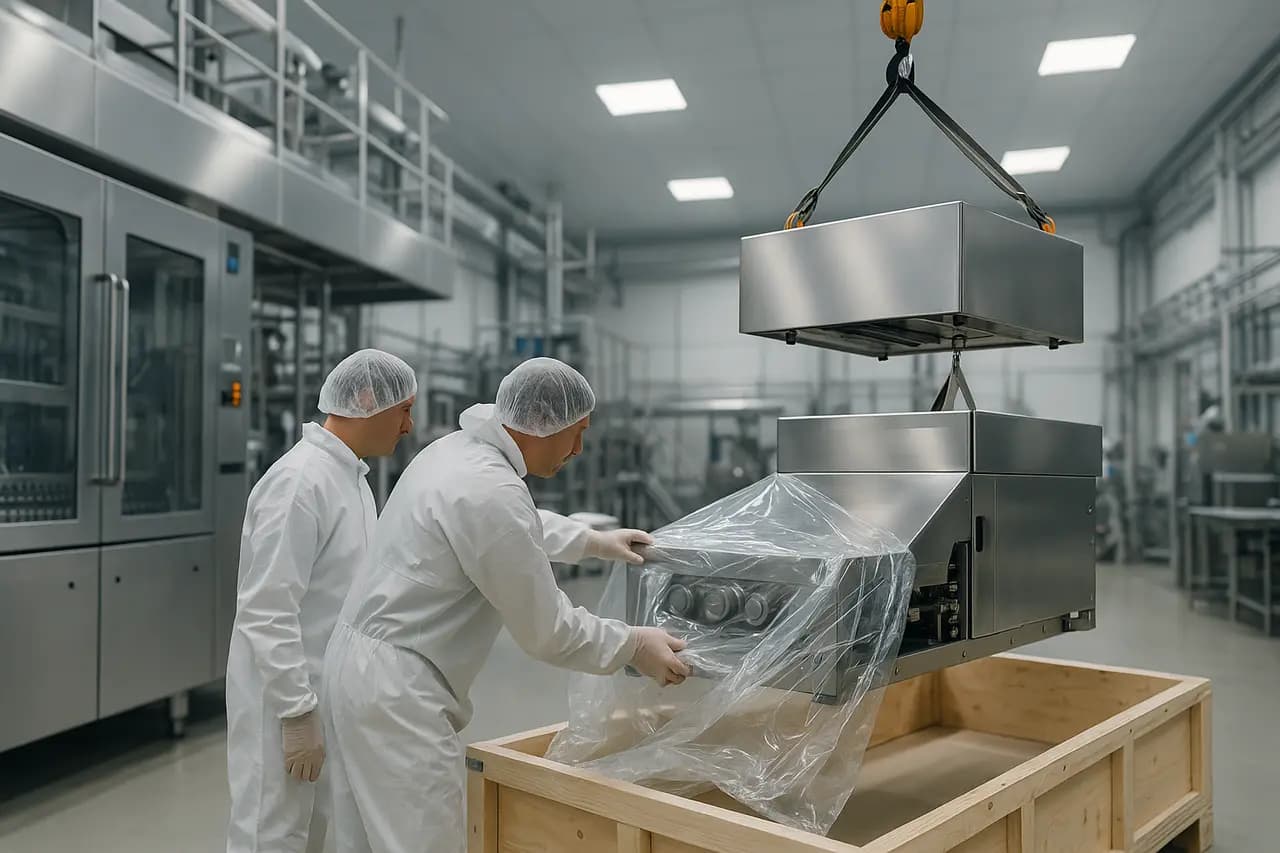
- Protect sterile surfaces — cap open ports, wrap sterile-zone components and label everything so it stays contamination-free during transit.
Dismantling with reassembly in mind
The golden rule: dismantle so that reassembly is fast and error-free.
- Match-mark mating flanges, guards and adjustable components before separating them, so original positions can be restored.
- Label every cable, hose and connector at both ends with a consistent tagging scheme that matches your documentation.
- Keep modules intact where possible. Splitting the line into logical transport units (filler, forming section, distribution equipment, straw/cap applicators) reduces reconnection risk compared with full teardown.
- Preserve alignment references. Note shim stacks, leveling data and baseplate positions so geometry can be reproduced at the destination.
Delicate assemblies — forming and sealing units, vaporizers, servo drives and control cabinets — should be removed carefully and packed as high-value fragile items.
Packing, marking and transport
Aseptic components dislike moisture, vibration and contamination. Protective packing should reflect that.
- Use vapor-barrier wrapping with desiccant for electronics and clean-surface components.
- Provide vibration isolation and secure blocking for servo units, drives and sealing heads.
- Crate control cabinets upright, cushioned, and shielded from condensation.
- Mark crates with center of gravity, lifting points, orientation and fragility indicators.
- Fit shock and tilt indicators on the most sensitive crates to verify handling on arrival.
For cross-border moves within the EU, plan load restraint and lashing to the actual mass and geometry of each unit, and confirm whether any items qualify as oversized transport requiring special permits and routing.
Destination readiness
The line should not arrive before the site is ready to receive it.
- Confirm foundations, floor flatness and load capacity for the filler and heavy modules.
- Verify all utilities: compressed air quality, sterile air, steam, chilled water, power supply and quality, drainage and the cleanroom/hygiene environment.
- Stage rigging routes and access clearances so heavy units can be moved to their final positions without improvisation.
- Ensure ambient conditions (temperature, humidity, cleanliness) match what the line requires.
Reassembly, leveling and reconnection
Rebuild in reverse of the documented dismantling sequence.
- Set and precisely level the filler and heavy modules to the recorded reference values; even small deviations can affect forming and sealing.
- Reconnect media and electrical services against your tagging scheme, then pressure-test and leak-check pneumatic and fluid systems.
- Restore PLC/HMI software, servo parameters and recipes from the verified backups.
- Reinstall guards, safety devices and interlocks, and confirm the safety circuit functions correctly.
Commissioning and revalidation
This is where an aseptic move differs sharply from a general machine relocation: producing again is not enough — you must prove the line is sterile and stable.
- Dry cycling — verify motion, sealing pressures and register control without product.
- Sterilization qualification — re-sterilize the sterile zone and confirm the barrier holds.
- Seal integrity testing — check package seals against specification.
- Microbiological validation — run the agreed sterility and incubation tests before releasing product to market.
- Performance verification — confirm speed, waste rate and OEE against pre-move baselines, and document a site acceptance test.
Only after microbiological and packaging integrity are confirmed should commercial production resume.
Minimizing downtime
Downtime is the biggest cost driver in a food-line move. Reduce it by sequencing work so cleaning, dismantling, transport and site prep overlap where safe; pre-staging spare seals, gaskets and consumables that are typically renewed during reassembly; and scheduling OEM or specialist support to arrive exactly when needed. A detailed, milestone-based plan — with clear ownership and validation gates — is what separates a smooth restart from an expensive, drawn-out one.
Relocating a Tetra Pak or comparable aseptic line rewards discipline: thorough documentation, contamination control, precise reassembly and rigorous revalidation. Handled methodically, the line can restart with its original hygiene performance and output — without leaving product safety to chance.
Related
Ernest Parfentiev
Founder & Managing Director, NM SOLUTIONS
NM Solutions specializes in the dismantling, relocation, installation and commissioning of industrial equipment and production lines across Europe — with hands-on project experience in metallurgy, food, packaging and building-materials plants.