
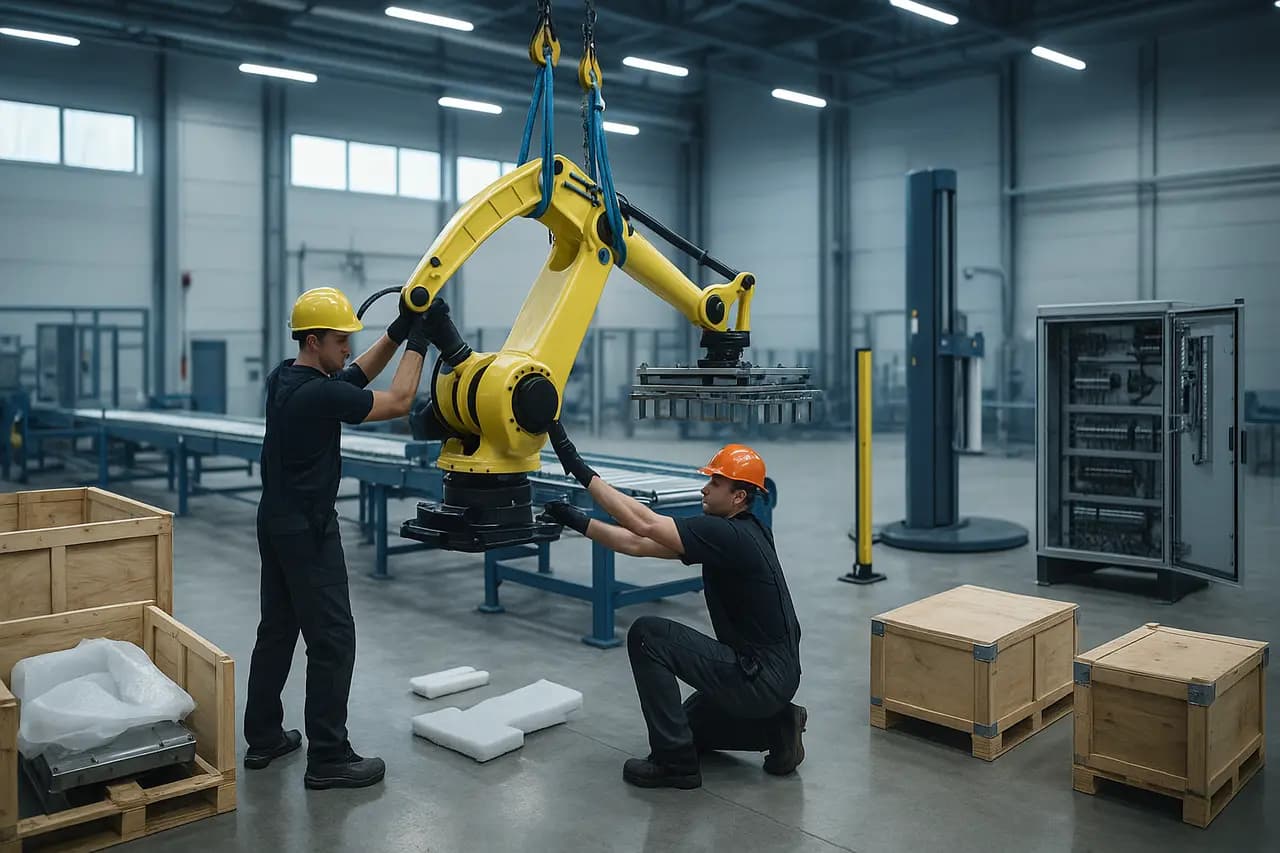
Relocating Palletizers & End-of-Line Packaging Automation
Ernest Parfentiev · Founder & Managing Director, NM SOLUTIONS
End-of-line automation is where a plant's output becomes shippable pallets — and where a botched relocation shows up fastest as missed dispatch windows. Palletizers, robotic pick-and-place cells, case packers, stretch wrappers and the conveyor spurs that link them are dense with mechanics, servo drives, safety guarding and integration logic. Moving them well takes more than a forklift and a truck. This guide walks through relocating end-of-line packaging automation from planning to a validated restart.
Why End-of-Line Systems Are Their Own Challenge
Upstream machines often run standalone. End-of-line equipment is different: it is a network of interlinked cells that hand product from one to the next, synchronized by a line controller. A single palletizing area may combine a conveyor merge, a case former, a robotic or gantry palletizer, a pallet dispenser, a stretch wrapper and a labeler — each with its own drives, sensors and safety zone.
That interdependence creates specific relocation risks:
- Loss of line synchronization if signal wiring and network topology are not documented.
- Damage to delicate end-effectors — vacuum grippers, layer clamps, servo wrists.
- Misaligned transfers at every handover point after reassembly.
- Safety circuit gaps if light curtains, gates and area scanners are not restored exactly.
Treat the whole cell as one system, not a collection of separate machines.
Phase 1: Survey and Document Before Anything Moves
The quality of your restart is decided during the survey. Capture the current state in enough detail that the line can be rebuilt without guesswork.
What to record
- Layout and footprint: distances between cells, conveyor centerlines, transfer heights, guarding positions. A 3D scan of the area saves enormous time later.
- Electrical and network architecture: control cabinets, drive assignments, fieldbus topology (PROFINET/EtherNet/IP), IP addresses, node numbers.
- Pneumatics and utilities: air pressure and consumption per station, vacuum generation, data drops, power feeds.
- Photos and labeling: photograph every cable termination, connector and mechanical adjustment before disconnecting.
Back up the intelligence
Before powering down, back up PLC programs, HMI projects, robot programs, servo parameters and vision-system recipes. Note the exact software and firmware versions. Robotic palletizers in particular store learned positions and payload data that are painful to recreate — export them and store copies in at least two locations.
Phase 2: Plan for Minimal Downtime
End-of-line moves are often on the critical path because nothing ships without them. Reduce risk with sequencing.
- Phase the shutdown: if the destination is ready, dismantle in the reverse order you will reassemble, so the first thing off the truck is the first thing installed.
- Consider a temporary manual fallback: some plants palletize by hand for a short bridging period, keeping dispatch alive while automation is offline.
- Pre-stage the destination: floor marking, anchor points, power drops and compressed air should be in place before the equipment arrives.
- Book the OEM or integrator early for any remastering, vision recalibration or software support you cannot do in-house.
Phase 3: Safe Dismantling
Apply full lockout/tagout and energy isolation — electrical, pneumatic and any stored mechanical energy — before opening a single guard. Robotic arms and gantry axes can carry gravitational load; support and secure them before releasing brakes or drives.
A practical dismantling sequence:
- De-energize and isolate the cell; verify zero energy.
- Move the robot to a transport pose and lock the axes per the manufacturer's instructions. Never sling from the wrist or end-effector.
- Remove and protect end-effectors — grippers, vacuum heads and clamps travel separately in cushioned crates.
- Detach guarding, light curtains and area scanners, labeling each to its exact mounting position.
- Disconnect and cap pneumatics; bag and tag fittings.
- Segment conveyors at natural joints; label drive units, motors and belts.
- Match-mark bolted interfaces so alignment references survive the move.
Keep fasteners, shims and small components in labeled kits tied to their parent assembly. A shim lost in transit becomes hours of trial-and-error alignment later.
Phase 4: Packing and Transport
End-of-line equipment mixes heavy steel frames with sensitive electronics and optics. Pack accordingly.
- Robots: secure in the specified transport position, protect the wrist and connectors, and cushion against shock and vibration.
- Control cabinets: transport upright, restrain internal components, and protect against moisture with desiccant and wrapping.
- Vision cameras and sensors: remove where practical and pack as fragile optics.
- Conveyors and framework: palletize or crate by section, protecting rollers, belts and drive shafts.
- Servo motors and drives: keep matched pairs together and clearly cross-referenced to their axis.
Label every crate with weight, center of gravity, lifting points and orientation arrows. A clear packing list keyed to the reassembly plan makes unloading orderly rather than a scavenger hunt.
Phase 5: Reinstallation and Alignment
Rebuild in reverse of the dismantling sequence, working outward from a fixed reference. Precision at the transfers is everything.
- Set the anchor cells first — typically the palletizer base and the main conveyor spine.
- Level and align conveyors so transfer heights and centerlines match the survey; small height mismatches cause jams and product damage at speed.
- Reinstall guarding and safety devices in their documented positions and verify the safety circuit before any powered motion.
- Reconnect utilities: power, compressed air and network, confirming correct phase rotation and air pressure.
Phase 6: Commissioning and Restart
Restore the backed-up software, then bring the line up in stages rather than all at once.
- Restore programs and parameters: PLC, HMI, robot programs and vision recipes; confirm firmware versions match.
- Remaster the robot if reference has been lost, and re-verify learned pick and place positions with the actual product and pallet pattern.
- Recalibrate vision systems to the new lighting conditions — ambient light at the destination often differs and affects detection.
- Dry-run each cell, then run handovers between cells at low speed before ramping to rated throughput.
- Validate safety functions: e-stops, light curtains, gate interlocks and muting devices, documented as part of acceptance.
Run a Site Acceptance Test against defined criteria — throughput, pallet pattern accuracy, wrap quality, reject handling — before signing off. Confirm whether the move triggers any renewed conformity obligations for the modified installation, and document the as-built configuration.
The Payoff of Doing It Right
End-of-line automation rewards discipline. Thorough documentation, backed-up intelligence, careful handling of robots and optics, and a staged restart turn a high-risk move into a predictable one. Get the transfers aligned and the safety circuits verified, and the line resumes shipping pallets at rated speed — which is the only measure of success that dispatch will care about.
Related
Ernest Parfentiev
Founder & Managing Director, NM SOLUTIONS
NM Solutions specializes in the dismantling, relocation, installation and commissioning of industrial equipment and production lines across Europe — with hands-on project experience in metallurgy, food, packaging and building-materials plants.