
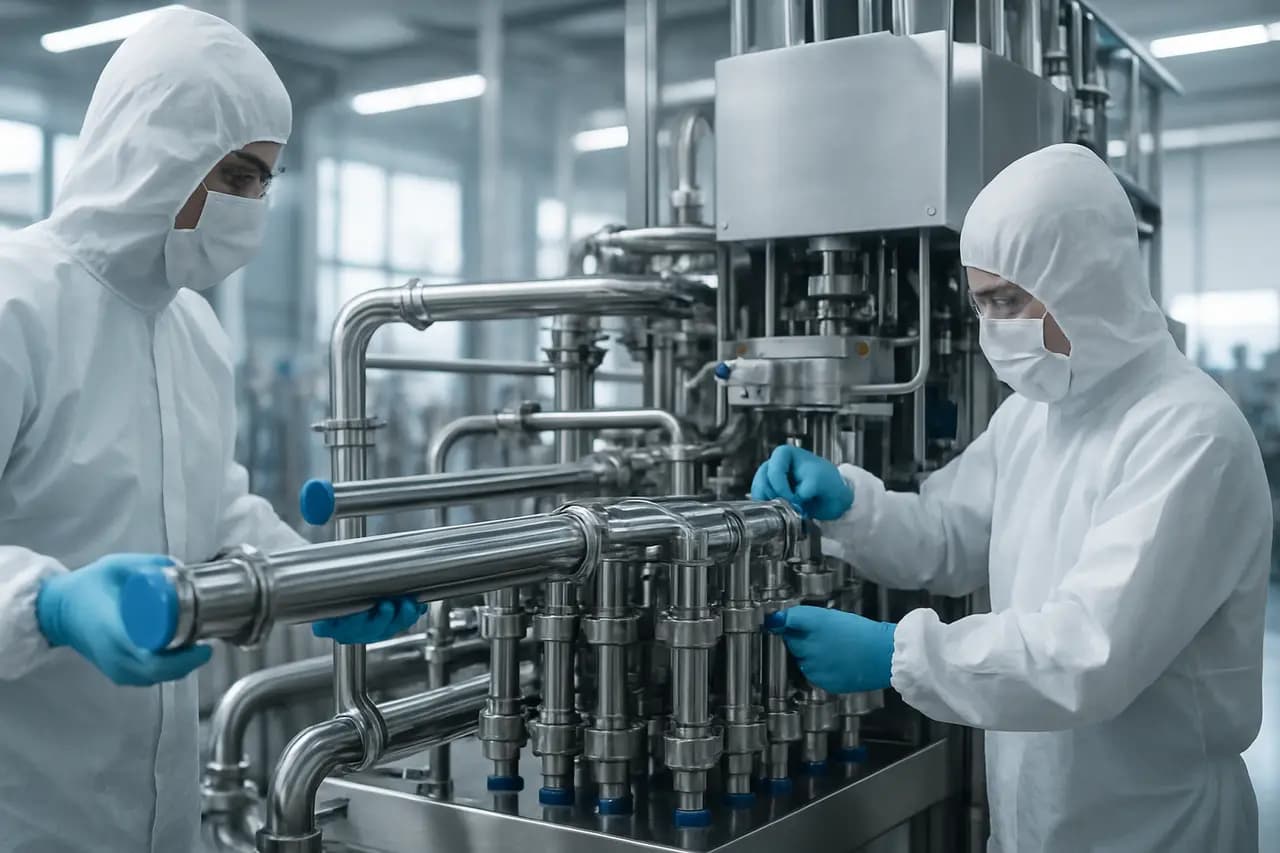
Relocating Aseptic Food & Beverage Lines Without Losing Hygiene
Ernest Parfentiev · Founder & Managing Director, NM SOLUTIONS
Moving an aseptic filling or packaging line is one of the most demanding jobs in industrial relocation. Unlike a standard machine move, these lines must come back into service with full sterility assurance — meaning hygiene, material traceability, and validation cannot be compromised at any point. A misaligned filler, contaminated product-contact surface, or undocumented disassembly can turn a successful lift into a failed re-commissioning and weeks of lost output.
This guide explains how to plan and execute the relocation of aseptic food and beverage lines, including carton-filling systems such as Tetra Pak, so that the line restarts clean, validated, and production-ready.
Why Aseptic Lines Are a Special Case
Aseptic processing relies on a sterile product path, sterile packaging material, and a controlled environment maintained from sterilization through sealing. Everything that touches product — pipes, valves, tanks, the filling chamber, and the sterile zone — is part of a qualified system. When you dismantle that system, you break the documented chain of cleanliness.
The relocation goal is therefore not just to move equipment safely, but to preserve or restore the conditions that make the line eligible for production. That means treating the move as a controlled change, not simply a logistics exercise.
Key risks to control
- Contamination of product-contact surfaces during dismantling, transport, and reassembly.
- Loss of calibration and alignment on fillers, dosing systems, and sealing units.
- Damage to sensitive components such as sterilization heaters, peroxide systems, sensors, and servo drives.
- Documentation gaps that prevent the line from being re-qualified after the move.
Plan Around Hygiene and Validation, Not Just Transport
Start the project with a combined team: relocation engineers, the production/quality function, and ideally the OEM or a specialist familiar with the specific line. The relocation scope should be written so that hygiene and validation requirements drive the sequence of work.
Build a component and hygiene map
Before touching anything, document the line in detail:
- Photograph and tag every product-contact assembly.
- Record pipe routing, valve positions, and CIP/SIP circuit connections.
- Note serial numbers, software versions, and parameter sets for fillers and controllers.
- Identify which components must remain sealed and which can be transported open.
This map becomes the master reference for reassembly and for the quality team's re-qualification plan.
Decide the cleaning strategy up front
There are usually two viable approaches:
- Clean before move: run a final CIP/SIP cycle, then protect and seal the product path so it travels as clean as practical.
- Clean after install: transport with capped openings, then perform full cleaning and sterilization once reconnected at the new site.
Most projects use a hybrid: a documented final clean before disassembly, full protection during transit, then a complete CIP/SIP and re-sterilization before any qualification runs. Agree this with quality early, because it defines how components are packed.
Controlled Dismantling
Dismantling an aseptic line is a precision job. Disconnect utilities — steam, compressed air, water, electrical, and any hydrogen peroxide or sterilant supply — following lockout/tagout and the manufacturer's shutdown procedure.
Protect what matters
- Cap and seal all open pipe ends and valve ports immediately after disconnection using food-grade caps or shrink covers.
- Bag product-contact parts in clean, labelled packaging; keep them physically separate from structural or dirty components.
- Mark orientation and torque-critical joints so reassembly matches the original specification.
- Remove and pack sensitive electronics and sensors separately, in anti-static and cushioned packaging.
Keep the dismantling photo log going throughout. Each disconnected interface should be traceable back to the hygiene map.
Packaging and Transport
Aseptic equipment combines heavy frames with delicate, precisely aligned modules. Protective packaging should reflect that mix.
- Use vibration-damping and shock-monitoring measures for fillers and servo-driven modules; shock indicators flag rough handling during transit.
- Apply moisture and corrosion protection (desiccants, VCI film) for stainless and product-contact parts that must stay clean.
- Climate considerations matter: condensation inside sealed surfaces can compromise cleanliness, so control how parts are wrapped and stored.
- Secure the load against shifting; over-dimensional sections may need dedicated framing or crating.
Label every crate against the inventory so the receiving team can stage components in install sequence.
Reinstallation: Rebuild to Specification
Reassembly is where the move is won or lost. Set the line on a prepared, level foundation with verified utility connections before bringing modules together.
Reconnect and align
- Reassemble in reverse of the documented dismantling sequence.
- Restore pipe routing and valve positions exactly as mapped.
- Re-align and re-level the filler and sealing units; many faults trace back to alignment skipped during reinstall.
- Reload verified software, parameter sets, and recipes; confirm against your records.
Reinstate utilities and the sterile envelope
Reconnect steam, air, water, electrical, and sterilant supplies, then leak-test and pressure-test the relevant circuits before any production-contact use.
Cleaning, Sterilization, and Re-Validation
Once the line is mechanically and electrically complete, hand it to the qualification process. A practical re-commissioning path includes:
- Installation checks (IQ-style): confirm components, utilities, and connections match specification.
- Functional checks (OQ-style): verify CIP/SIP cycles reach required temperatures, times, and coverage; confirm sensors, dosing, and sealing operate within tolerance.
- Performance/sterility verification (PQ-style): run sterility and integrity tests, then trial production, before releasing product for sale.
CIP and SIP cycles should be run and documented to confirm the product path is clean and sterile again. Seal-integrity testing on packaging — and microbiological sampling per your quality plan — provides the evidence that the line is fit for aseptic production.
Keep all results in the relocation dossier alongside the dismantling and reassembly logs. This documentation is what lets the quality team formally release the line.
Practical Tips to Reduce Downtime
- Prepare the new site in parallel — foundations, utilities, drains, and clean staging area — so installation starts the moment equipment arrives.
- Pre-order consumables for the first cleaning and sterilization cycles so re-validation isn't delayed.
- Schedule the OEM or specialist for the alignment and re-commissioning window in advance.
- Run a dry walkthrough of the reassembly sequence with the install crew before the line arrives.
The Bottom Line
Relocating an aseptic food or beverage line is as much a hygiene and validation project as an engineering one. The teams that succeed treat documentation, surface protection, and re-qualification as core deliverables — not afterthoughts. With a detailed hygiene map, disciplined dismantling, protective transport, and a structured cleaning and validation restart, an aseptic line can move across a plant or across Europe and resume production with full confidence in product safety.
Ernest Parfentiev
Founder & Managing Director, NM SOLUTIONS
NM Solutions specializes in the dismantling, relocation, installation and commissioning of industrial equipment and production lines across Europe — with hands-on project experience in metallurgy, food, packaging and building-materials plants.