
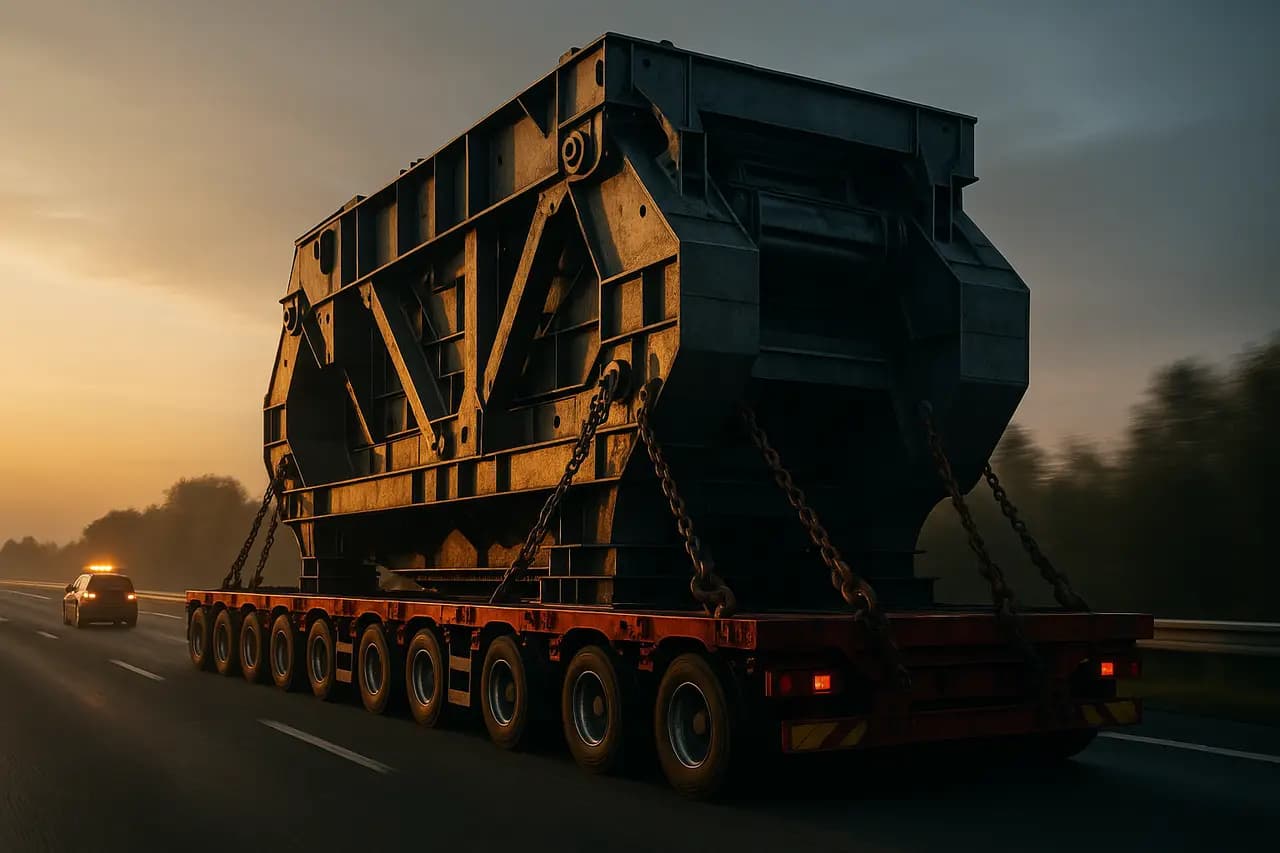
Oversized Machinery Transport Across Europe: A Practical Guide
Ernest Parfentiev · Founder & Managing Director, NM SOLUTIONS
Moving a single press, a vessel, or a complete production module across European borders is rarely as simple as booking a truck. Once a load exceeds standard legal dimensions or weight, it enters the world of abnormal (over-dimensional) transport — a regulated process where permits, route surveys, and escort vehicles determine whether the machine arrives on schedule or sits at a border for days. This guide explains how to plan oversized machinery transport across Europe and where projects typically go wrong.
When Does a Load Become "Abnormal"?
A shipment is classed as abnormal (or "exceptional") when it exceeds the standard limits permitted for a vehicle in a given country. While exact thresholds vary by jurisdiction, the common reference points across most of the EU are:
- Width above roughly 2.55 m (refrigerated/standard) up to 3.0 m and beyond
- Height above approximately 4.0 m total vehicle height
- Length beyond the standard articulated combination (around 16.5 m)
- Gross weight exceeding national axle and total-weight limits (commonly 40–44 t)
The moment any one dimension is exceeded, you need a permit — and the permit is country-specific. A single move from Poland to Spain may require separate authorizations from each transit country, each with its own lead time, rules, and validity window.
Why this matters early
The dimensions of the transported item are fixed by the machine, but the dimensions of the load are not. Choosing the right trailer, removing protruding parts, or partially disassembling a unit can sometimes bring a shipment back under a threshold — saving weeks of permitting. This decision must be made during planning, not at the loading dock.
The Route Survey: The Single Most Important Step
For any genuinely oversized load, a physical or detailed desktop route survey is non-negotiable. Permits are granted for a specific route, and that route must be proven passable. A survey checks:
- Bridge load ratings and weight-bearing capacity along the corridor
- Vertical clearances: overpasses, tunnels, gantries, overhead cables, traffic lights
- Horizontal constraints: roundabouts, tight bends, narrow village streets, central reservations
- Surface and gradient issues for very heavy axle loads
- Temporary obstacles: roadworks, seasonal restrictions, market days
Many delays trace back to a clearance or turning radius that was assumed rather than measured. For repeat corridors, experienced carriers keep survey data, but a machine that is taller or wider than previous loads invalidates that history.
Choosing the Right Trailer
The trailer type is dictated by weight, dimensions, and centre of gravity. Common options include:
- Flatbed / extendable flatbed — for long but standard-height loads
- Low-loader (low-bed/step-frame) — lowers the deck to keep tall machinery under height limits
- Modular hydraulic platform trailers (SPMT) — self-propelled or towed, with steerable axle lines for the heaviest and most awkward units; axles can be added to spread weight and satisfy bridge limits
- Well-deck / drop-deck — for items needing extra vertical clearance in the centre
The goal is always to balance the load, keep the centre of gravity low and central, and distribute weight so that no single axle exceeds permitted limits. This is engineering, not guesswork — load distribution calculations should accompany the transport plan.
Permits, Escorts, and Timing
Permits
Each country has its own authority and process. Some issue annual or area permits for moderate excesses; the most extreme loads require individual, route-specific authorizations. Lead times vary widely — from a few days to several weeks for the largest shipments crossing multiple borders. Building permit lead time into the project schedule is essential; treating it as a formality is a frequent and expensive mistake.
Escort and pilot vehicles
Depending on dimensions, authorities require:
- Private pilot/escort vehicles front and/or rear to warn traffic and guide the load
- Police escort for the largest loads, urban transits, or moves requiring temporary road closures or traffic-signal lifting
Escort requirements differ between countries, so a single journey may switch escort regimes at each border.
Time-of-day and seasonal restrictions
Many countries restrict abnormal transport to night-time, prohibit movement on weekends and public holidays, or impose summer/holiday-season bans on certain corridors. These windows shape the entire schedule and must be aligned with crane and installation crews waiting at the destination.
Securing and Protecting the Load
Oversized machinery is often high-value and sensitive to shock, moisture, and ingress. Effective load security combines:
- Rated lashings and chains matched to the load weight, with documented securing points
- Cradles, frames, and dunnage to support the machine at engineered contact points rather than fragile surfaces
- Weatherproofing — shrink wrap, VCI protection, or covers for long international transits
- Shock and tilt indicators for delicate equipment, providing evidence if mishandling occurs
Lashing must reflect the load's centre of gravity and the dynamic forces of braking, cornering, and acceleration — not just static weight.
Insurance and Documentation
Standard cargo policies rarely cover the full replacement value of a critical production machine plus the consequential downtime. Confirm:
- All-risk transit insurance at the correct declared value
- Liability coverage for road and third-party damage along restricted routes
- Complete transport documentation: permits, route plan, load-securing certificate, and customs paperwork where non-EU borders are involved
Keep a clear chain of responsibility: who owns the risk at loading, in transit, and at unloading.
Coordinating Both Ends
Abnormal transport is only one link in the chain. The schedule must synchronise:
- Dismantling and loading at origin, with the correct lifting equipment
- The transit window, including escorts and night-driving rules
- Cranes and rigging crews ready at destination — idle mobile cranes are a major cost
- Installation and commissioning teams to begin work without delay
A load that arrives a day early to a site with no crane, or a crane booked for a load delayed at a border, both burn budget fast.
Common Pitfalls to Avoid
- Underestimating permit lead times in transit countries
- Skipping a route survey and discovering a low bridge mid-journey
- Measuring the machine but forgetting the full vehicle height and width
- Ignoring seasonal or weekend bans that compress the schedule
- Booking the destination crane before the transit window is confirmed
The Takeaway
Successful oversized machinery transport across Europe is won in the planning phase. Confirm dimensions and weight, decide whether partial disassembly changes the permit class, commission a proper route survey, and align permits, escorts, and crane crews into one realistic timeline. Treated as an integrated logistics and engineering exercise — rather than a simple haulage booking — abnormal transport becomes predictable, and your machine arrives ready to install on schedule.
Ernest Parfentiev
Founder & Managing Director, NM SOLUTIONS
NM Solutions specializes in the dismantling, relocation, installation and commissioning of industrial equipment and production lines across Europe — with hands-on project experience in metallurgy, food, packaging and building-materials plants.