
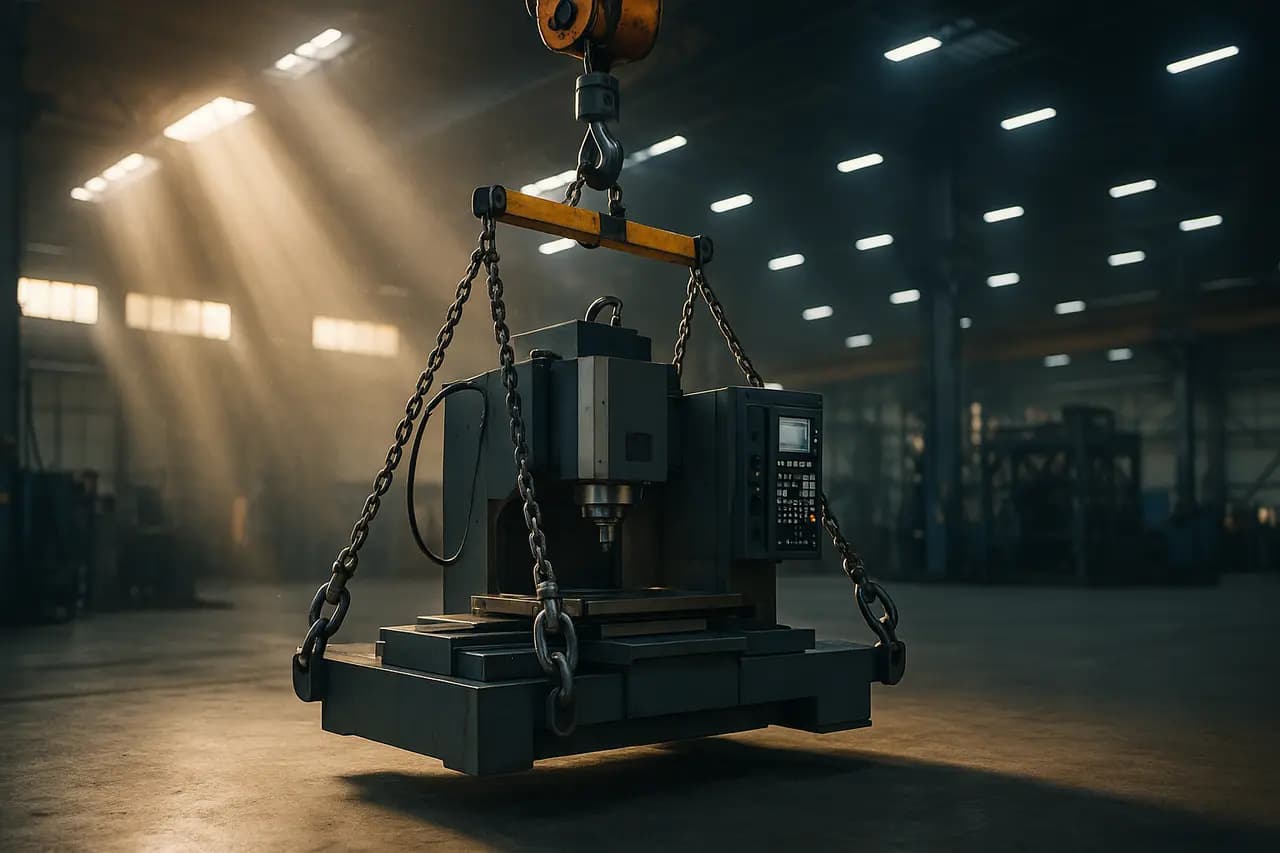
Machine Weight & Center of Gravity for Safe Lifts
Ernest Parfentiev · Founder & Managing Director, NM SOLUTIONS
Every safe heavy lift starts with two numbers: how much the machine weighs, and where its center of gravity (CoG) sits. Get these wrong and you risk shifting loads, overloaded slings, tipping during set-down, and cranes working outside their rated capacity. Yet weight and CoG are often estimated from a nameplate or a faded drawing — a habit that causes far too many near-misses during industrial relocations.
This guide explains how experienced riggers establish machine weight and CoG in the field, why it matters for every sling and shackle, and the practical checks to make before a load leaves the ground.
Why weight and center of gravity decide the whole lift
The total mass sets your minimum requirements for cranes, forklifts, lifting beams, slings, shackles and anchor points. The CoG determines how that mass is distributed between the lifting points and whether the load will hang level.
When the CoG is off-center — common on machines with a heavy gearbox, hydraulic unit, or motor on one side — the sling nearest the CoG carries a disproportionate share of the load. A crude 50/50 assumption can overload one leg by 30–50% while the machine tilts on pick. A tilting load can also swing, snag, or slide out of poorly positioned slings.
Getting CoG right lets you:
- Position lifting points so the load lifts level and stable
- Size each sling leg to its actual share of the load
- Keep the hook directly above the CoG to avoid side-loading
- Plan set-down onto skates, plates or a foundation without tipping
Methods to determine machine weight
1. Documentation and nameplates
Start with the manufacturer's data: technical datasheets, foundation drawings, transport manuals, or the machine nameplate. These are a good baseline but treat them with caution. Nameplate mass often excludes fluids, tooling, dies, product residue, guarding, or field-added accessories. A machine can be significantly heavier in service than when it left the factory.
2. Calculation from geometry and materials
For fabricated frames and structures you can estimate mass from volume and material density (steel ≈ 7,850 kg/m³, cast iron ≈ 7,200 kg/m³, aluminum ≈ 2,700 kg/m³). This is useful for custom or undocumented equipment but is only as good as your dimensional measurements — always add a margin for hidden mass.
3. Direct weighing
When accuracy matters, weigh it. Options include:
- Load cells or dynamometers in the rigging line between hook and load — the most reliable field method, giving a live reading during trial lift.
- Weigh pads or portable scales placed under the machine feet before disconnection.
- Crane load indicators, useful as a cross-check but affected by rigging weight and boom geometry.
A calibrated dynamometer on a controlled trial lift is the gold standard: it confirms both total weight and, when combined with sling readings, hints at CoG offset.
Finding the center of gravity
Visual and design assessment
Identify heavy sub-assemblies: motors, gearboxes, hydraulic power units, transformers, spindles, counterweights, and fluid reservoirs. The CoG shifts toward the mass. On tall machines it may also sit high, which raises tipping risk during transport and set-down.
The two-scale (reaction) method
Support the machine on two known points and measure the reaction (weight) at each with load cells or weigh pads. The CoG lies closer to the heavier reading. With reactions and the distance between supports you can calculate the CoG position along one axis; repeat perpendicular to locate it in the other axis. This is a practical, accurate approach for skid-mounted or footed equipment.
Trial lift and observation
Raise the load a few centimeters — no more — with adjustable rigging (chain hoists or a spreader with multiple attachment holes). If the load tilts, the hook is not above the CoG. Lower, adjust the pick point toward the low side, and repeat until it hangs level. This iterative "inch and check" method is standard practice and should never be rushed.
Turning the numbers into a safe rigging plan
Once you know weight and CoG, translate them into hardware selection:
- Sling load share: with an offset CoG, calculate the tension in each leg individually rather than dividing the load equally. The leg closest to the CoG carries more.
- Sling angle factors: as the angle from horizontal decreases, tension rises sharply. A 45° leg carries about 1.4× the vertical load; at 30° it is 2×. Keep angles as steep as practical and never below the manufacturer's minimum.
- Working load limits (WLL): select slings, shackles and lifting beams so each component's WLL exceeds its actual calculated share, with the appropriate safety factor.
- Attachment points: use certified lifting lugs or manufacturer-designated points. If none exist, engineer them — do not sling around fragile guards, pipework, or machined surfaces.
- Spreader and lifting beams: use these to keep slings vertical over an offset CoG and to protect the machine from crushing compressive loads.
Field checklist before the lift
- Confirm total weight from at least two sources (e.g. documentation plus trial-lift dynamometer).
- Account for fluids, dies, tooling, and residual product — drain or document them.
- Locate the CoG in both horizontal axes and note if it is high.
- Mark the CoG and designated lifting points clearly on the machine.
- Verify crane capacity at the required radius, plus rigging weight, stays within the load chart.
- Check sling angles, WLL of every component, and edge protection at contact points.
- Do a controlled trial lift; confirm the load hangs level and stable before full pick.
- Keep personnel out from under and around the load; use tag lines to control swing.
Common mistakes to avoid
The most frequent errors are trusting an outdated nameplate, ignoring fluids and add-ons, assuming a symmetrical CoG on an asymmetrical machine, and skipping the trial lift to save time. Another is forgetting that transport orientation matters: a high CoG that is stable on a crane hook can become unstable on a low-loader over uneven ground, so the same data feeds your transport securing plan.
The bottom line
Accurate weight and CoG data are not paperwork formalities — they are the foundation of every safe heavy lift and a core part of a proper lift plan and method statement. Combining reliable documentation, sound calculation, and direct field measurement removes guesswork and protects people, machines, and schedules. When equipment is undocumented, heavily modified, or unusually shaped, weighing and CoG determination should be treated as a mandatory step, carried out by an experienced lifting team before anything leaves the floor.
Related
Ernest Parfentiev
Founder & Managing Director, NM SOLUTIONS
NM Solutions specializes in the dismantling, relocation, installation and commissioning of industrial equipment and production lines across Europe — with hands-on project experience in metallurgy, food, packaging and building-materials plants.