
Lockout/Tagout & Energy Isolation for Safe Dismantling
Ernest Parfentiev · Founder & Managing Director, NM SOLUTIONS
Before a single bolt is loosened on a machine that is about to be dismantled and relocated, one question decides whether the job is safe or dangerous: has every source of energy been isolated, locked and verified as zero? Stored electrical, hydraulic, pneumatic, mechanical and thermal energy causes some of the most severe accidents on dismantling sites. This guide explains how to apply lockout/tagout (LOTO) and energy isolation correctly when preparing production lines and heavy machinery for a move.
Why energy isolation is critical during dismantling
A running factory has active, controlled energy. A machine scheduled for dismantling is often the opposite: half-decommissioned, partially disconnected, with people reaching inside guarding that would normally never be opened. Crews unbolt actuators, cut cables, break flanges and rig heavy sub-assemblies. Any unexpected release of energy in that environment can be fatal.
The most common stored-energy hazards on a dismantling site include:
- Electrical: main supply, control voltages, UPS/battery backup, capacitor banks and drives that retain charge.
- Hydraulic: accumulators and cylinders holding pressure even after the pump is off.
- Pneumatic: air receivers, cylinders and reservoirs under pressure.
- Mechanical: suspended loads, spring tension, gravity (counterweights, raised platforms, flywheels).
- Thermal: hot surfaces, ovens, molten material, steam and heated fluids.
- Process/fluid: residual chemicals, gases or product trapped in pipes and vessels.
Energy isolation is not just an electrical task. It is a systematic shutdown of every energy type a machine can hold.
Building the isolation plan
Safe dismantling starts on paper, not with a wrench. For each machine or line section, the team should prepare a machine-specific isolation procedure before mobilisation.
Identify all energy sources
Use P&IDs, single-line diagrams, pneumatic/hydraulic schematics and — where documentation is missing — a physical walk-down. Older machines in factories being emptied often have undocumented modifications, so treat drawings as a starting point, not gospel. Photograph and label everything before disconnection; this pays off enormously during reinstallation.
Map the isolation points
For every energy source, define:
- the isolation device (breaker, disconnect switch, valve, blind flange, chock, pin);
- the correct isolated state (open/closed, blocked, blanked);
- how stored energy will be dissipated (bleeding accumulators, venting air, discharging capacitors, blocking gravity loads);
- who is authorised to operate it.
Assign roles
A clear structure prevents confusion: authorised persons who perform isolation, affected persons working under the isolation, and a competent supervisor coordinating group lockout. On relocation projects with multiple contractors, roles must be agreed in writing during the pre-start briefing.
The LOTO sequence in practice
A reliable lockout/tagout sequence follows the same logic regardless of machine type:
- Notify everyone affected that the machine is being shut down and locked out.
- Shut down the equipment using the normal stopping procedure.
- Isolate every energy source at its isolation device.
- Lock and tag each device. Each worker applies their own personal padlock; the tag identifies who, when and why. Nobody removes another person's lock.
- Release stored energy: bleed hydraulic and pneumatic pressure, discharge capacitors, block or lower suspended parts, allow hot components to cool, drain fluids into controlled containers.
- Verify zero energy: this is the step most often skipped and the most important.
Verifying zero energy is not optional
Tagging a breaker "off" proves nothing until you test. Verification means measuring, not assuming:
- Test electrical dead with a proven voltage tester (test the tester on a known live source, test the circuit, re-test the tester).
- Confirm hydraulic and pneumatic gauges read zero and try to operate the equipment controls to confirm no movement.
- Physically check that gravity loads are supported and can't shift.
Only after verified zero energy does mechanical dismantling begin.
Group and multi-contractor lockout
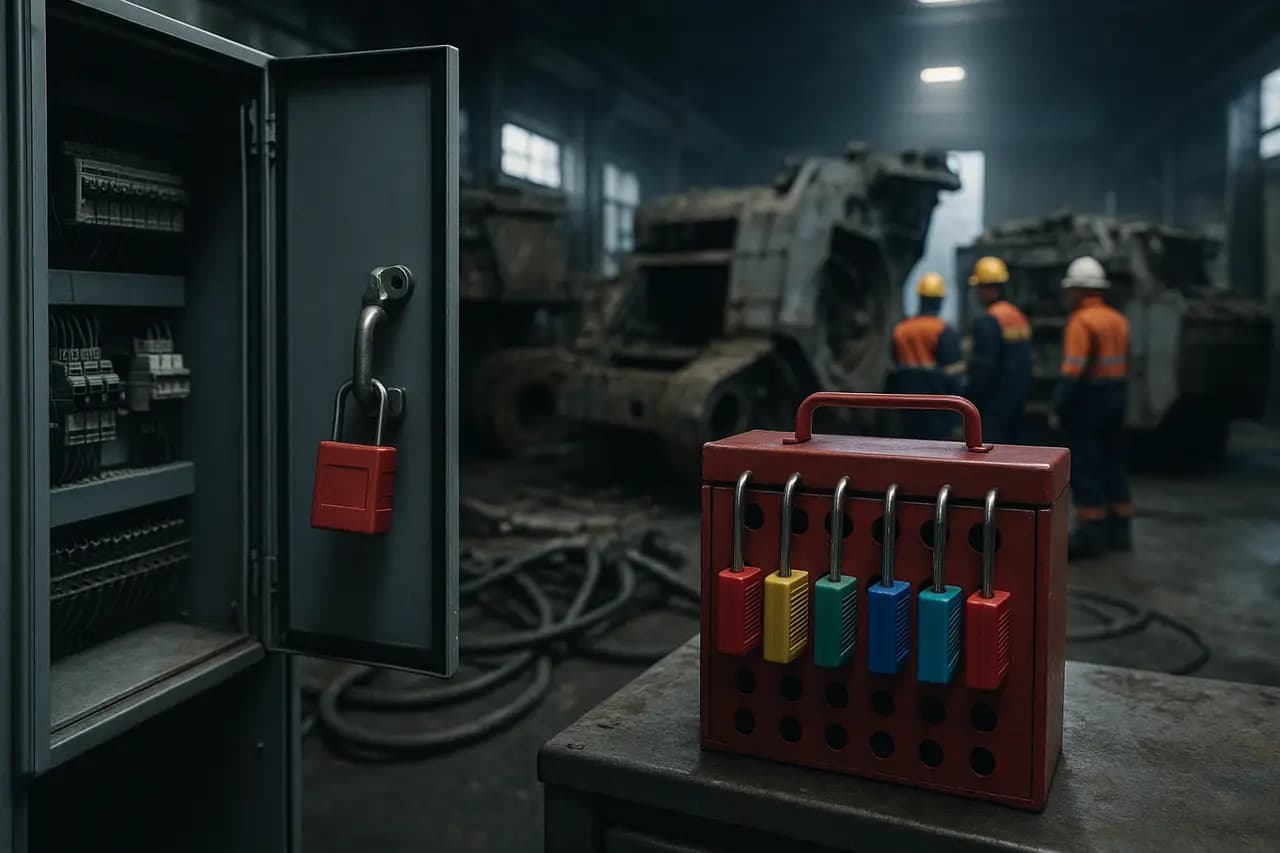
Machine relocation rarely involves a single technician. Riggers, electricians, pipefitters and crane operators may all work on the same asset. A group lockout using a lockbox keeps this safe: the isolation is performed once, the operating keys go into a lockbox, and every worker attaches a personal lock to that box. The energy cannot be restored until the last person removes their lock. This guarantees that no line is re-energised while anyone is still exposed.
On large sites, coordinate lockout across all trades in a single permit-to-work system so nobody "borrows" an isolation for another job.
Special cases you cannot overlook
- Capacitors and drives: variable-frequency drives and DC-bus capacitors can hold lethal charge for minutes after disconnection. Respect manufacturer discharge times before touching terminals.
- Hydraulic accumulators: these store enormous energy independently of the pump. Isolate and bleed them deliberately; a closed accumulator can drive a cylinder even with the main power off.
- Gravity and springs: counterweights, ram/slide assemblies on presses, and tensioned belts must be mechanically blocked or de-tensioned before disassembly.
- Trapped product and fluids: pipes and vessels may still contain hot, pressurised or hazardous media. Drain, vent and, where required, purge and gas-test before breaking connections.
- Interconnected lines: on packaging, filling or Tetra Pak-style lines, adjacent machines share utilities. Isolating one unit while its neighbours keep running requires clear boundaries and, ideally, physical breaks.
Documentation and handover
Energy isolation on a relocation project generates records that protect people and support the later reinstallation:
- Machine-specific isolation procedures and lock logs.
- Photographs of cable, hose and pipe connections before disconnection, with matching labels on both ends.
- A register of removed fluids and how they were handled.
- Sign-off that zero-energy verification was completed before dismantling.
These documents feed directly into commissioning at the new site. Well-labelled connections and a clean isolation record dramatically shorten reassembly and reduce errors during restart.
Common mistakes on dismantling sites
- Relying on a stop button or PLC instead of a physical isolation device.
- Locking out electrical power but forgetting pneumatic, hydraulic or gravity energy.
- Skipping the zero-energy test because "the breaker is clearly off."
- One person locking out on behalf of a whole crew.
- Removing isolations early to "quickly test" something while people are still working.
The bottom line
Energy isolation and lockout/tagout are the foundation of safe machine dismantling and relocation. The discipline is simple to describe and unforgiving when ignored: identify every energy source, isolate it, lock and tag it, release stored energy, and verify zero before any tool touches the machine. Combined with disciplined labelling, this practice keeps crews safe on the way out and makes the machine far easier to reinstall on the way in. A relocation partner that treats LOTO as a core competency — not an afterthought — is protecting both your people and your production schedule.
Related
Ernest Parfentiev
Founder & Managing Director, NM SOLUTIONS
NM Solutions specializes in the dismantling, relocation, installation and commissioning of industrial equipment and production lines across Europe — with hands-on project experience in metallurgy, food, packaging and building-materials plants.