
Commissioning After a Machinery Move: A Re-Validation Guide
Ernest Parfentiev · Founder & Managing Director, NM SOLUTIONS
Moving a production line is only half the job. The moment a machine arrives at its new floor, the real risk to your schedule begins: getting it powered up, aligned, and producing in-spec parts again. Commissioning and re-validation are where a relocation either succeeds quietly or turns into weeks of unplanned downtime. This guide walks through a practical, structured approach to bringing equipment back online after a move — without cutting corners on quality or safety.
Why commissioning deserves its own plan
Dismantling and transport get most of the attention, but re-installation and start-up are where hidden problems surface: connectors that loosened in transit, foundations that settled differently, utilities that don't match the original site, or controls that lost their parameter backups. Treating commissioning as an afterthought is the most common reason a "two-week move" stretches into a month.
A dedicated commissioning plan does three things:
- Defines the exact sequence from energization to full-rate production.
- Assigns responsibility for each check (mechanical, electrical, controls, process, quality).
- Sets measurable acceptance criteria so everyone agrees when the line is truly "done."
Start with a baseline before you ever dismantle
The best re-validation starts at the old site. Before disconnecting anything, capture the machine's healthy state so you have something to compare against later.
Capture and document
- Reference run data: cycle times, throughput, scrap rate, energy draw, key process values (temperatures, pressures, torque).
- Controls backups: PLC programs, HMI projects, drive parameters, recipes, safety configurations — exported and verified, not just assumed to exist.
- As-found measurements: shaft alignments, belt tensions, level readings, critical clearances.
- Photos and cabling records: label every connection, hose, and pneumatic line; photograph terminal blocks and connector orientations.
This baseline is your single most valuable asset during commissioning. Without it, you are debugging blind and arguing about whether a fault is "new" or "always there."
The mechanical re-installation checks
Once the equipment is positioned on its new foundation, mechanical integrity comes first. Energizing a misaligned machine multiplies damage quickly.
Levelling and alignment
- Confirm the machine sits level within the manufacturer's tolerance using precision levels.
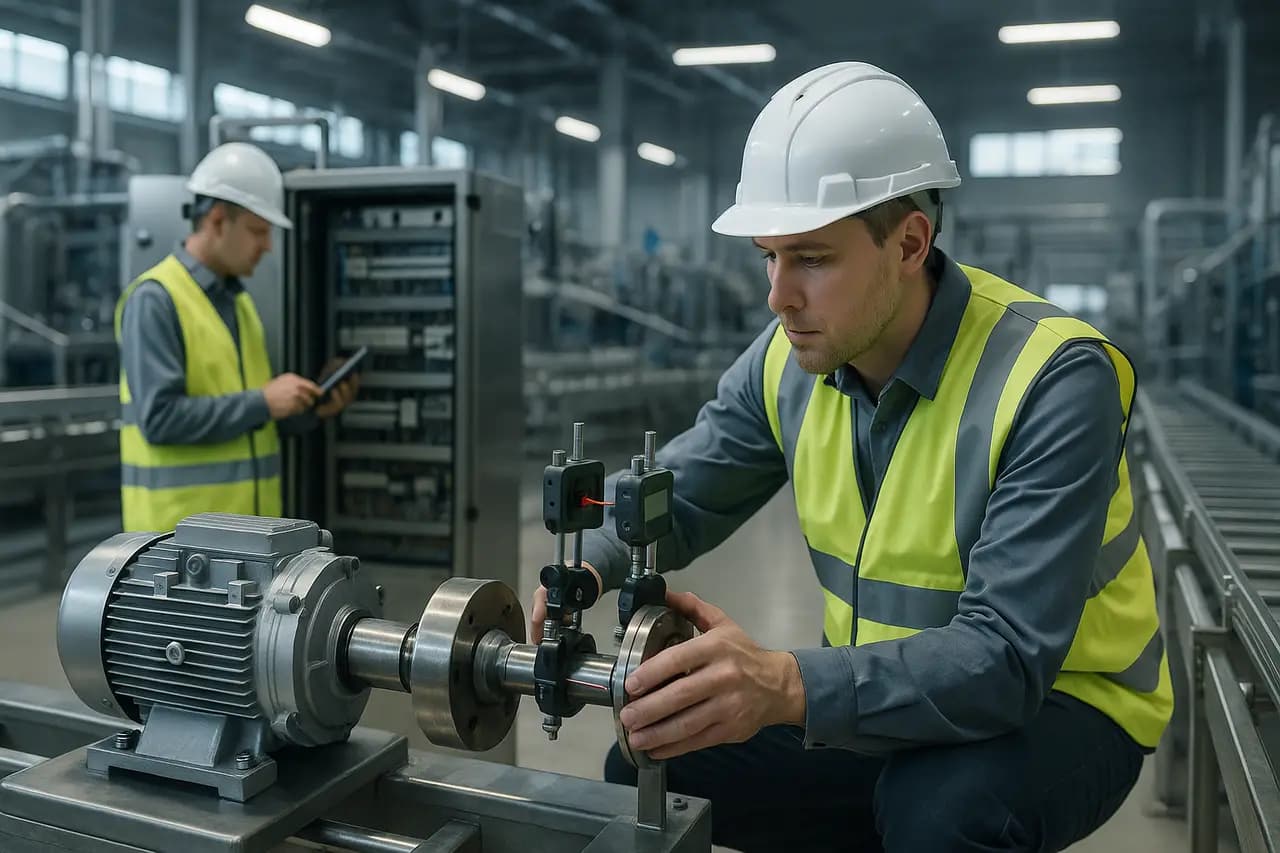
- Re-check shaft and coupling alignment with dial indicators or laser alignment tools — transport vibration and a new foundation almost always shift it.
- Verify anchor bolts are torqued to spec and that grout or anti-vibration mounts have cured/set.
Structural and motion checks
- Inspect for transit damage: bent guards, deformed frames, loosened fasteners.
- Turn drives by hand where possible to confirm free movement before applying power.
- Re-tension belts and chains, and re-lubricate points that were drained for transport.
Utilities and services: match, don't assume
A frequent surprise after an international move is that the destination site's utilities differ from the origin. Voltage, frequency, water hardness, compressed-air quality, and exhaust capacity all affect performance.
- Electrical: confirm supply voltage, phase rotation, and frequency match the machine's rating. Phase rotation errors will run motors backwards — verify before loading.
- Pneumatics and hydraulics: check pressure, flow, and air dryness; bleed lines and inspect for leaks under pressure.
- Cooling and process media: validate water/steam quality and temperature, especially for food and packaging lines where media quality is a hygiene factor.
- Compliance: ensure the new installation meets local EU regulations, including grounding, machinery directive conformity for any modifications, and electrical safety standards.
Controls, software, and safety systems
With mechanical and utility checks passed, restore the brains of the machine.
- Reload the verified PLC, HMI, and drive parameters from your backups — never type them in from memory.
- Confirm sensor and encoder signals read correctly before motion is enabled.
- Test safety functions individually: E-stops, light curtains, interlocked guards, two-hand controls, and safe-torque-off circuits. Document each test.
- Validate network communication for any integrated or automated cells, including handshakes with upstream and downstream equipment.
Safety systems are non-negotiable. A relocated machine effectively re-enters service and the people operating it must be protected exactly as before.
Staged start-up: dry, then wet, then loaded
Resist the temptation to jump straight to full production. A staged ramp isolates faults cheaply.
- Dry run / no load: cycle the machine empty to confirm motion, sequencing, and timing.
- Functional run with media but no product: introduce air, water, or lubricant flows; check for leaks and correct actuation.
- First-product run at reduced speed: produce a small batch and inspect output closely.
- Ramp to rated speed: increase incrementally, monitoring vibration, temperature, and quality at each step.
At every stage, compare live data against the baseline you captured before dismantling.
Re-validation: IQ, OQ, PQ
For regulated sectors — food, packaging, pharma-adjacent — formal re-validation is often required after a relocation. The three-stage framework is widely understood:
- Installation Qualification (IQ): documents that the equipment is installed correctly to specification — utilities connected, components present, calibrations valid.
- Operational Qualification (OQ): confirms the machine operates correctly across its intended ranges — speeds, temperatures, alarms, safety responses.
- Performance Qualification (PQ): demonstrates it consistently produces conforming product under real production conditions.
For a packaging or filling line such as a Tetra Pak-style aseptic line, PQ may include sterility checks, seal integrity testing, and fill-volume verification across a sustained run. Define sample sizes and pass/fail limits in advance so the sign-off is objective.
Calibration and quality verification
Instruments drift during handling. Re-calibrate or verify:
- Load cells, scales, and fill sensors.
- Temperature and pressure transmitters.
- Vision systems and metrology equipment.
- Torque tools and tensioners.
Produce a documented first-article inspection and compare critical dimensions and quality metrics to the original baseline before releasing the line to operations.
Handover and documentation
Commissioning ends with a clear sign-off, not a vague "it seems to work."
- A completed commissioning checklist with measurements and acceptance criteria.
- Updated documentation: revised layout drawings, utility connections, and any field changes.
- Calibration certificates and safety test records.
- A short operator and maintenance refresher, especially if the layout or services changed.
- An agreed punch list for minor items and a defined window of post-start-up support.
Common pitfalls to avoid
- No baseline data — you can't prove the line returned to spec.
- Skipping phase-rotation and safety checks to save time, then chasing damage later.
- Assuming utilities are identical across sites or countries.
- Compressing the ramp and treating the first full-speed run as a test.
- Losing controls backups during the move, leaving you to reverse-engineer parameters.
The bottom line
Commissioning is the discipline that converts a physical relocation into a working asset. Capture a solid baseline before dismantling, verify mechanical and utility integrity methodically, restore controls from trusted backups, ramp up in stages, and close out with formal IQ/OQ/PQ where it applies. Done well, re-validation protects product quality, satisfies regulators and auditors, and gets your line earning again with confidence rather than crossed fingers.
Ernest Parfentiev
Founder & Managing Director, NM SOLUTIONS
NM Solutions specializes in the dismantling, relocation, installation and commissioning of industrial equipment and production lines across Europe — with hands-on project experience in metallurgy, food, packaging and building-materials plants.